Tiếng Đức translated into English is “German” /ˈdʒɜːr.mən/. This is one of the most popular European languages today, with an increasingly growing demand for translation. So, what is “nước Đức” in English? Let’s take a look at the article below.
No.1 Translation provides comprehensive German-to-English translation services for all needs, from basic translation, localization, notarization to consular legalization. Contact 0934.888.768 for consultation and a quotation.
What Is Germany Called in English?
What is “nước Đức” translated into English? “Nước Đức” in English is Germany, pronunciation: /ˈdʒɜːmənɪ/ (IPA). Besides Germany, the country may also be referred to by several other names in English such as:
- Deutschland (the official name of Germany)
- The Federal Republic of Germany
- Germanic Republic
Besides, the abbreviated name of Germany in English is “DE”, based on the ISO 3166-1 alpha-2 country code. In some contexts, “GER” is also commonly used, especially in international sporting events.
👉 See more: German-speaking countries today
Where Does the Name Germany Come From?
After understanding which country Germany refers to, let’s explore the origin of this name. The English name “Germany” originates from the ancient Germanic tribes. In prehistoric times, the Germanic people mainly lived in a region known as Germania – a vast territory in what is now Central and Northern Europe.
The Germanic language began to develop strongly after the emergence of the Runic writing system around 1800 BC. By the 1st century AD, due to contact with Roman civilizations, the Germanic language became increasingly widespread among Latin-speaking communities.
Over many centuries, the descendants of the Germanic people continuously expanded their linguistic and cultural influence, forming various Germanic ethnic groups. From this historical development, Germany is called “Germany” in English today – a name that reflects the origin and history of this nation.
Do Germans Speak English?
English is not the official language in Germany. However, because there are many similarities between English and German, many people choose to learn English as a second language.
Theo báo cáo Chỉ số thông thạo tiếng Anh toàn cầu (EF EPI 2024), Đức xếp vị trí thứ 10 trong số các quốc gia sử dụng tiếng Anh như một ngôn ngữ thứ hai. Khảo sát cho thấy khoảng 56% người dân Đức có khả năng giao tiếp tiếng Anh thành thạo, tuy nhiên mức độ này sẽ có sự phân hóa dựa trên yếu tố thế hệ và khu vực địa lý.
👉 See more: Which is harder, English or German??
Similarities Between German and English
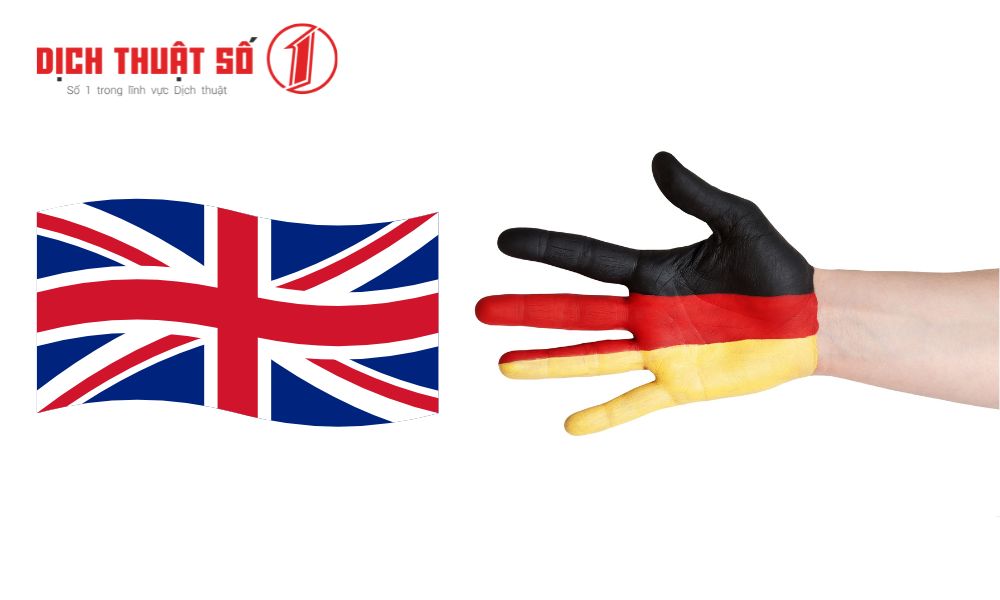
- Vocabulary: Many words in German and English originate from the same Germanic root.
Example:
=> German: Mutter (mother) – English: mother
=> German: Vater (father) – English: father
=> German: Haus (house) – English: house
Although there are many shared vocabulary items, there are also many differences between the two languages. For example, the word “car” in English is “Auto” in German.
- Sentence structure: Both German and English follow a subject – verb – object structure. However, German is more flexible in word order.
- Grammar: Both languages have similar grammatical systems, including tenses, aspects, and complex verb conjugations.
- Pronunciation: German has some sounds that do not exist in English, such as the “ch” sound in “Bach” and the “ü” sound in “Mutter”.
Top 5 Free Websites for German-to-English Translation
If you need to translate German into English quickly and do not require high professional accuracy or complex localization, free translation websites are an ideal solution.
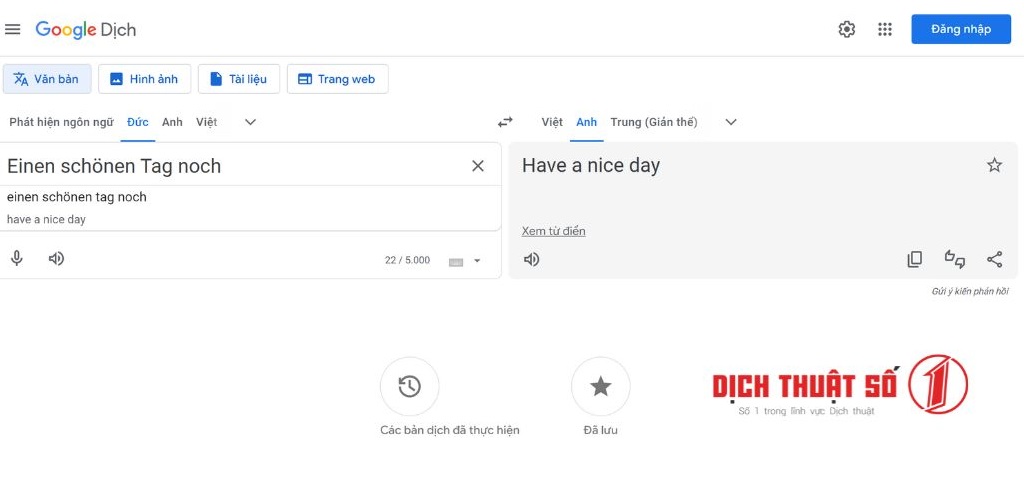
Google Translate German to English
Google Translate is one of the most popular online translation tools today, supporting fast and accurate translation from German to English. It can quickly translate from single words to long sentences, suitable for various needs ranging from study to work.
The tool not only translates text but also supports voice translation, allowing you to communicate in German and instantly receive English translations. In addition, Google Translate offers image translation via camera, helping you translate handwritten or printed text without retyping.
However, for specialized documents or content requiring deep localization, the translations may not be perfect.
Cambridge Dictionary
Cambridge Dictionary is an ideal tool when you need to translate German into English, especially for vocabulary or phrases with complex meanings. In addition to providing accurate translations, it offers detailed explanations and example sentences, helping you better understand word usage in different contexts.
A notable advantage of Cambridge Dictionary is its provision of International Phonetic Alphabet (IPA) pronunciation, helping you pronounce English words correctly when translating from German. Its dictionary system also includes concrete examples from various sources, making translations clearer and more user-friendly.
Although Cambridge Dictionary cannot translate long paragraphs like some automatic translation tools, its detailed explanations and illustrative examples make it an excellent resource for language learners and those who want to understand meanings and usage in specific contexts.
German-to-English Translation at Wordcount.com
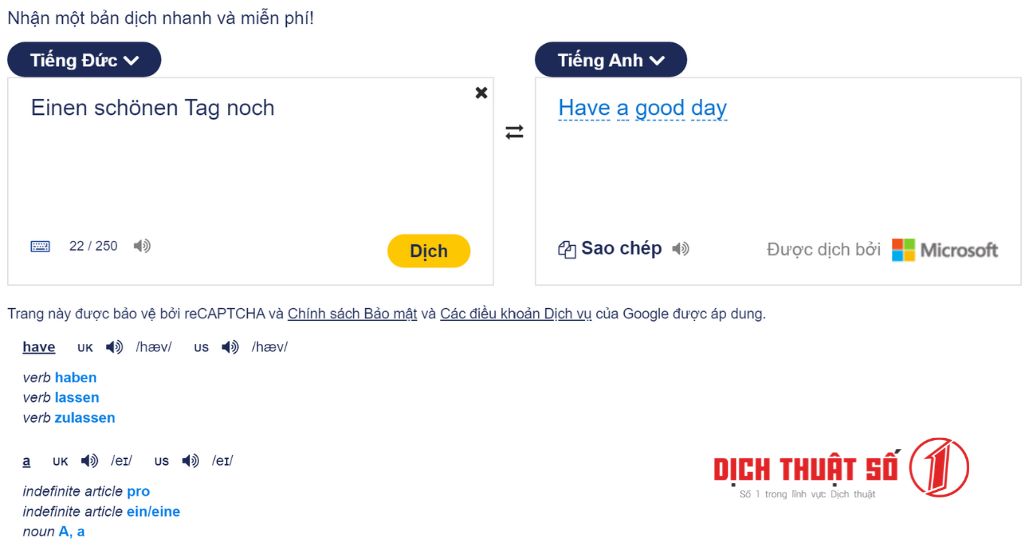
Wordcount.com is a simple yet effective translation tool, well suited for translating short words and phrases from German into English. With a user-friendly interface, users simply enter German text and the tool quickly provides the English translation.
Although it does not support translating long passages or complex texts, Wordcount.com is a great choice when you need quick translations of short texts and want to check word counts.
4. Glosbe
Glosbe.com is a powerful online translation tool that helps users translate quickly and effectively from German into English. A special feature of Glosbe is that it not only provides simple translations but also offers real-life example sentences, helping you better understand how words and phrases are used in different contexts.
With a rich database from diverse sources, Glosbe allows users to look up and compare multiple translations for the same word or phrase, enabling you to choose the most suitable translation. This tool is especially useful when you need a deeper understanding of meanings and usage in specific situations.
AI-Based PDF Translation from German to English
Sider.ai is an artificial intelligence–powered tool that translates PDF documents from German into English quickly and accurately. With advanced AI technology, Sider.ai not only translates text but also preserves the original document formatting, helping users save time and effort when working with large files.
A key highlight of Sider.ai is its ability to handle complex PDF documents, including those with tables, images, and other formatting elements. This ensures that the translation is not only accurate but also retains the original structure and content of the document.
However, like many other machine translation tools, Sider.ai may struggle with texts that have complex semantics or require deep localization.
Native German-to-English translation services provided by No.1 Translation

No.1 Translation is the leading provider of professional German-to-English translation services. We are committed to delivering superior quality and meeting all customer needs with a team of 100% native translators.
- We guarantee that our translators are 100% native Germans with English certifications such as IELTS, TOEFL, etc., graduates of prestigious universities, and with at least 5 years of translation experience.
- Providing translation services across many fields such as medical, technical, finance, law, marketing, and communications, etc.
- Supporting translation in all document formats including images, scanned files, soft files, PDF files, videos, design files, etc.
- 24/7/365 consultation; quick quotations within 15–20 minutes; doorstep delivery of translations, notarization, and invoice issuance upon request.
- Offering translation services at competitive prices, suitable for a wide range of clients from individuals to businesses.
- Signing security NDA agreements with all clients to ensure 100% information confidentiality.
- Native translators can handle idioms, wordplay, and cultural references more effectively than non-native translators.
- Ensuring consistency throughout the entire translation, even for large or complex projects.
- Translating directly from German to English without intermediate Vietnamese translation, thereby delivering higher-quality translations in a shorter time.
👉 See more: English-to-German translation
German-to-English Translation Pricing
SOURCE LANGUAGE | TARGET LANGUAGE | BASIC PACKAGE VND/ 1 page | SPECIALIZED PACKAGE VND/ 1 page |
|---|---|---|---|
German | English | 400.000 310.000 | 450.000 330.000 |
English | German | 400.000 310.000 | 450.000 330.000 |
Why Should You Not Use German-to-English Translation by Vietnamese Translators?
While some Vietnamese translators may have good proficiency in both German and English, they are usually not native speakers of either language. Therefore, there are several limitations when using such translation services, including:
- Cultural inaccuracies: Vietnamese translators may not fully understand cultural nuances and expressions in German, leading to translations that are not entirely accurate or natural.
- Inappropriate style: The writing style of Vietnamese translators may not match the desired style and tone of the English translation.
- Translation time: German-to-English translation by Vietnamese translators may slow down the process and increase costs due to a two-step translation workflow (German–Vietnamese and Vietnamese–English).
In summary, to ensure accurate, high-quality, and culturally appropriate German-to-English translations, it is advisable to use services provided by native German translators who are fluent in English.
Let No.1 Translation help you convey your message clearly and effectively from German to English. Contact us today to receive a free quote and discuss your German-to-English translation needs.